
Executive Limousines. Range Rover vs. Mercedes vs. BMW (2016)
Features | EVO Middle East | crankandpiston
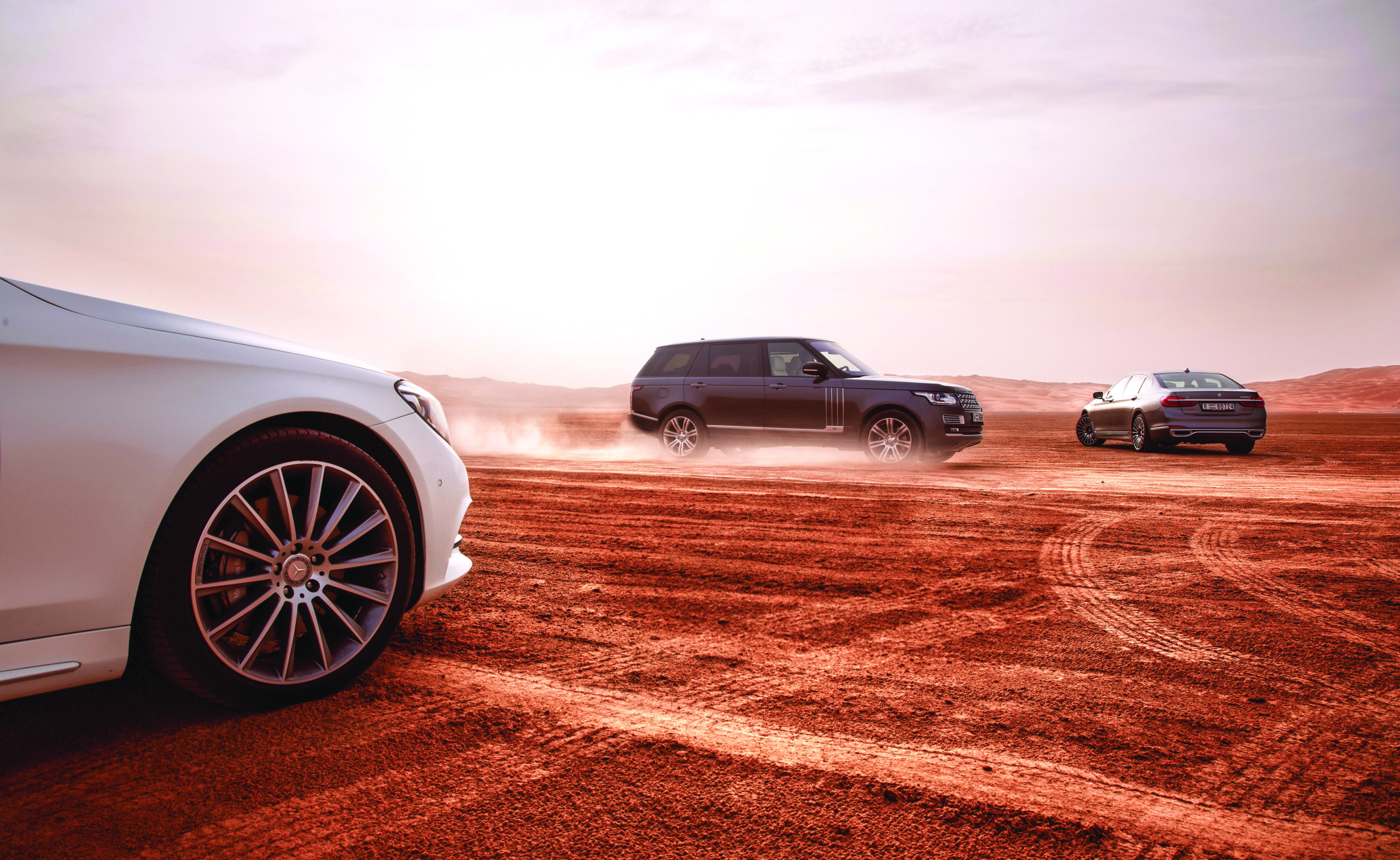
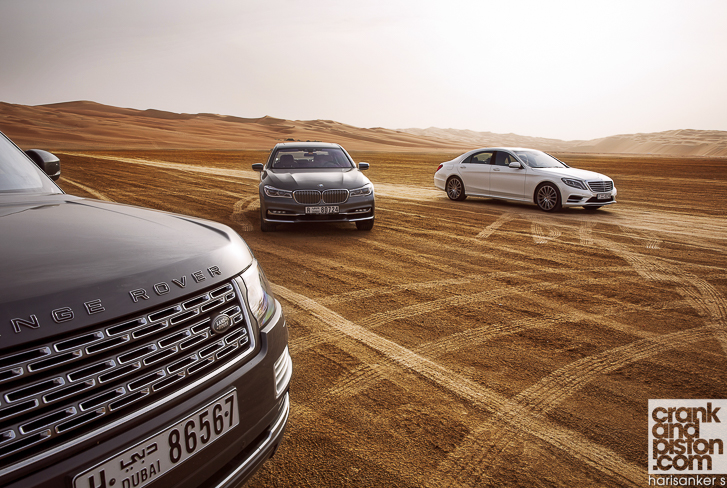
For many, the Mercedes-Benz S-Class is THE go-to executive limousine of choice. But has it met its match against the new BMW 7-Series and Range Rover’s SV Autobiography?
Originally posted – May, 2016 (crankandpiston.com / EVO Middle East magazine)
If you’re in the market for, and have the necessary funds to afford, an executive limousine, chances are you’ll choose a Mercedes-Benz S-Class.
Easy decision, right? After all, the S-Class has been the purveyor of luxury and technological innovation since its official debut in 1972. It’s introduced airbags, electronic stability control, disc brakes and independent suspension, changing the motoring world forever in the process. Throw in opulence that only Bentley and Rolls-Royce could offer at more than double the price, and it’s little wonder the S-Class set the bar, early doors.
That Mercedes took a ‘best or nothing’ approach to its new-for-2013 limousine speaks volumes about Stuttgart’s commitment to the “essence of luxury.” Far more than spit and polish, the sixth generation introduced a more efficient hybrid aluminium chassis, automated Magic Body Control suspension, and yet-further refined ride comfort, effectively picking up the baton left by the then-defunct Maybach brand. Interest from potential customers and motoring hacks alike were piqued. Clearly the Mercedes S-Class was still the executive limousine of choice.
Fast-forward two years. BMW had just launched the sixth generation 7 Series, and though the barely touched (albeit still muscular exterior) suggested little had changed, beneath the surface, things were very different. Alongside a range of new engines, extensive use of carbon fibre-reinforced polymer saw the overall kerb weight drop by a hearty 130kg. Steering, dampers and chassis had all received a tune-up, plus an array of driver assistance technologies and cabin comforts, including a Rolls-Royce-inspired ‘Sky Lounge’ panoramic glass roof.
In short, the new 7 Series had taken a massive step in the S-Class’ direction. That Bimmer’s flagship saloon beat the Bentley Mulsanne to evo’s Luxury Car of the Year award in 2015 – an accolade the S-Class walked away within 2013 – spoke volumes. Could it really be? Had the Mercedes S-Class, once the pillar of mainstream luxury, actually been toppled?
Traditionally this is where the ‘it’s 5am, we’re in Hatta, and we’re already knackered’ portion of our story begins. But we’ve yet to welcome our third contender…
“Might the Range Rover SV Autobiography actually overhaul the BMW 7 Series and the Mercedes S-Class as the best executive limousine available today?”
In 2012, Land Rover introduced only the fourth Range Rover in 42 years. One considerably more refined, though no less capable, than any of its predecessors. The looks were smooth and considerably less utilitarian. The ride was exemplary, and the cabin, loaded with leather upholstery, veneer detailing and touchscreen infotainment, was a far cry from the plastic floor mats and grab handles that had come before it. The words ‘Jaguar-esque’ were even uttered in hushed tones.
Truly this was a Range Rover that balanced off-road ability and day-to-day civility better than ever before, and it wasn’t long before the über plush, über swanky SV Autobiography arrived to demonstrate what the new, more premium Range Rover could really do.
And that’s got us curious. Could the most luxurious Range Rover to-date be considered an executive limousine? And if it does, could the SUV actually overhaul both the BMW 750Li and Mercedes’ S 500 as the best available today?
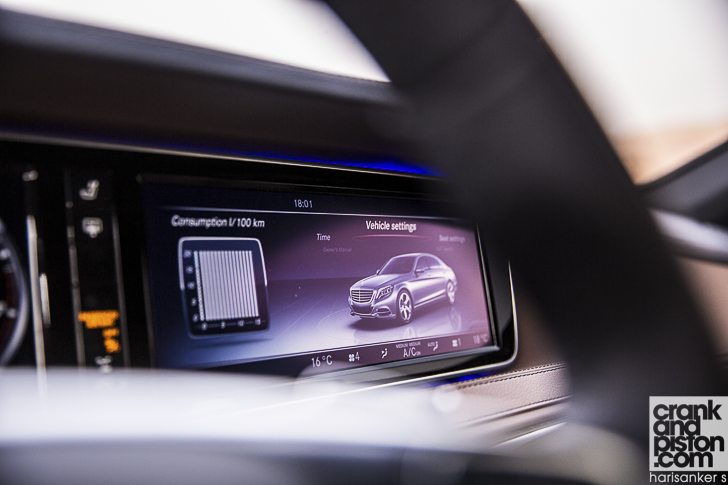



My investigation begins with the current benchmark, the S-Class. And as you would expect, the design and refinement on the inside borders on awe-inspiring. Compared with Mercedes’ button-heavy, overly fussy layout that now heads into retirement, the new dashboard is so minimalist and sweeping in its curvaceous design that it borders on artwork. It’s a theme that continues down the transmission tunnel, since a rotary dial for both TFT colour displays, a track pad and a couple of buttons is about it. A combination of meticulously cut leather and LED ambient light strips, meanwhile, ensure that nothing as ghastly as plastic (urgh…) graces our faux-executive peepers.
Head and legroom is cavernous, and even more so in the back, a result of Mercedes developing the S-Class in long wheelbase guise to begin with for the sake of torsional rigidity and greater passenger comfort. A commitment made yet clearer by the ride quality.
Sweet mother it’s good! One might even say faultless. At the base is the rather nauseatingly named Magic Body Control, the first suspension setup in the world with ‘eyes.’ By scanning the road ahead several bajillion times a second, the dampers are automatically configured to glide over even the roughest of asphalt, with nary a thump or bump coercing their way into the S 500 cabin. It’s a system so fastidious yet so subtle, you’d be forgiven for thinking the whole thing is done through witchcraft. Select the ‘Fast and Vigorous’ massage option on the magnificently recumbent seats to go cross-eyed.



A decisive early shot then for the Mercedes, despite BMW’s eye-popping design in the 750Li. Like the Merc, the previously chaotic centre console – akin to an explosion in a button factory – has been ripped clean from its moorings, replaced instead by a more elegant layout. BMW can’t help overcomplicating the design though, and while the system is more intuitive, still there are too many things going on. Too many sub-menus and too much switchgear to truly rival the S-Class’ elegance. Moreover, the front passenger – shock, horror – is denied a seat massager, and even the ride quality can’t quite hit the same level. The dynamic dampers are beautifully supple, granted, but don’t offer quite the same impact (or lack of) as the S-Class.
Saying that, I’ll admit that having the option of ‘Comfort Plus’ is a novelty that makes me grin (regular Comfort mode presumably isn’t enough for some delicate flowers). Head and legroom are equally as impressive, despite the BMW being slightly shorter, and some of the Bimmer’s new technology is genuinely interesting. We lose more time than we care to mention mulling our ‘Ambient Light’ choices before settling on Bronze without White accenting.
The highlight, however, is the BMW Display Key. It works like a mini iPad, allowing you to select climate control and media options from outside the vehicle. There’s even a Remote Parking option, meaning the driver doesn’t need to be in the car whilst reverse parking. The 750Li may not match the S 500’s sophisticated ride quality, but it stands tall on tech alone.

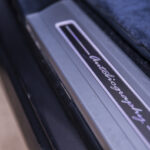


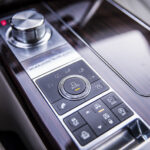
And what of the Range Rover? ‘SV,’ after all, denotes additional handiwork from Jaguar Land Rover’s Special Vehicles Operations, including plusher detailing and fluffier leather. Surely the crème de la crème of Range Rover has a decisive warning shot to fire?
Ironically, the exclusive front grille and an ‘SV Autobiography’ emblem aside, there’s little difference to the cabin design over the already excellent Range Rover base. The inset buttons on the dash are pleasing to both sight and touch. Infotainment and climate control are easy to navigate through a comparatively minimalist dashboard design. And we’ll probably never get bored of the rotary shift controller rising from the transmission tunnel on start-up.
“Sweet mother, the ride quality is good. One could even say faultless.”
In the back though, it’s a different matter. There’s a weighty centre console for rear passengers, seats that recline almost horizontally, buckets of head and legroom, a cooler, and deployable tables. Everything an executive might need on the cruise to the boardroom. Throw in stunning build quality and a couple of TV monitors, and at least one question is partially answered.
Where perhaps things start to go awry for the Range Rover is the ride comfort. Those 22in alloys may look the part, but they do not glide quite so effortlessly over the ground as either the BMW or Mercedes. Then there’s the suspension, which has been designed not just for graceful cruising on-road, but also for dynamic capabilities off it. As a result, the ride is not of the same exacting standard. Ironic, given that the cocooned nature of the cabin means wind and road noise are surprisingly good. Even with a 5-litre supercharged V8 under the bonnet.
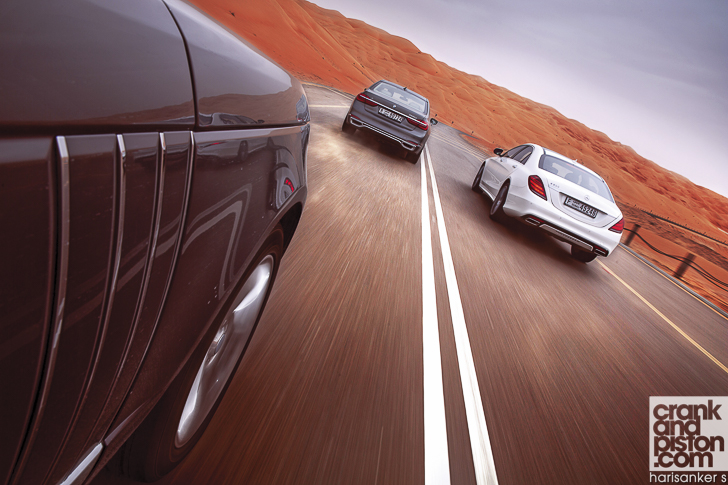
This particular fire-breather should be no stranger to fans of the Jaguar F-TYPE and Range Rover Sport SVR. In the SV Autobiography, it produces 542bhp and 671lb ft of torque, some 98bhp and 93bhp more than the BMW and Mercedes respectively. Despite the 2,560kg kerb weight, Britain’s colossus will hit 100kph from standstill in an impressive 5.2 seconds. In the face of such raw power then, the SV Autobiography is less than refined under heavy acceleration: punch the right pedal and you’ll feel the whole cabin tilt back. Said power delivery is slightly less ferocious than the SVR, granted, and doesn’t boast the same rampant V8 roar. But the impact is nothing less than extraordinary, as a strong opening kick in the lower revs slides effortlessly into a strong, linear (but no less visceral) pull across the range. Sure, the pick-up is breath-taking, but is ‘aggressive’ what we’re looking for from a luxury limousine?
In the German duo, it’s an entirely different matter. The BMW, for instance, houses a 444bhp 4.4-litre TwinPower Turbo V8 that spits out 516lb ft of torque and a 4.4 second 0-100kph time. Hardly slow then, and a wide torque curve means, despite the potential for turbo lag on this 1990kg land yacht, pull is ceaseless and yet, simultaneously, genteel. It’s a strong pick-up that lacks, while not the vigour, certainly the aggression of the Range Rover and the throaty V8 roar. The sensation of speed is much calmer and more relaxed, despite the sheer pace of which the 750Li is capable. Don’t let the civility of the delivery fool you: it’s deceptively quick.
Once again though, the S-Class top trumps its pretenders. The 4.7-litre V8 boasts 449bhp and 516lb ft of torque, which is delivered so smoothly you may not realise you’ve hit 100kph in 4.8 seconds. It’s extraordinary, as 449bhp delivered with neither aggression nor turbocharged peak, yet with such grace that the refined confines of the cabin are barely rocked. Once again the refinement of the S-Class is proving difficult to beat. That is until the big Merc hits the corners.
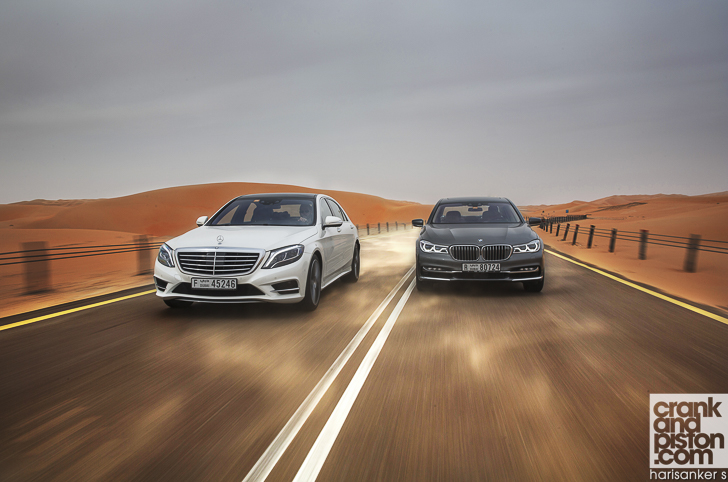
Unlike its AMG alter-ego, the sense of composure in the S-Class saloon is difficult to garner through even the longer, sweeping sections of road. Weight transfer and overly inundated suspension means the S-Class has a tendency to roll rather than remain planted through the corners. This is hardly helped by the seven-speed gearbox, whose insistence – as we’ve seen in the past from Mercedes – to upshift and deny downshifts at key moments can prove frustrating.
It’s not all doom and gloom, however. Yes, body roll through the corners is inevitable for a vehicle that’s 17ft long, but wider front and rear track allow a more stable base for the newly stiffened and more rigid chassis to cope with, if not contend with, lateral body movement. Similarly, steering feel leans heavily towards numb, such is the effectiveness of the power-assisted steering. Fortunately, the direct nature and crisp(ish) response mean there’s considerably more confidence to be had through the corners, particularly when the strong stopping power – if slightly wooden feel – through the brake pedal scrubs off speed astonishingly quickly. Sure, the S-Class saloon might not be the most ideal hoon machine on this stretch but that’s not to say the S-Class can’t roll up its Armani shirtsleeves on occasion.
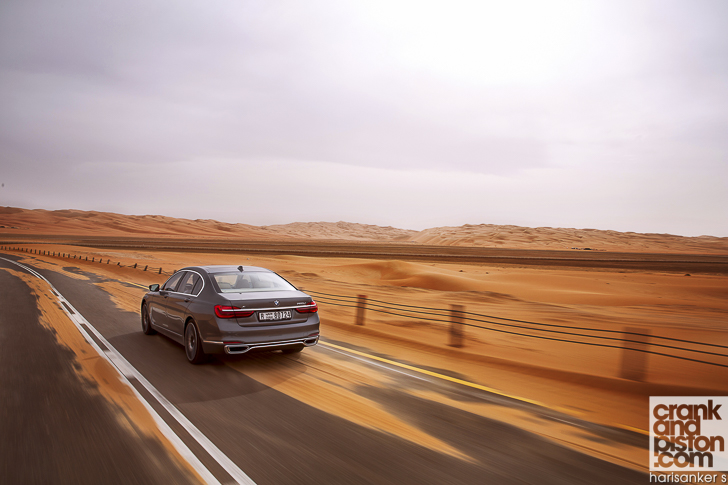
Full credit must go to 7-Series though. Like the Mercedes, the BMW packs nearly two tonnes, but the reactivity of that suspension and the rigidity of the carbon core chassis means the 750Li is astonishingly agile. Power is sent to all four wheels via the xDrive configuration ensuring enormous amounts of traction out of the corners. Into them, and unlike the S-Class, there’s a degree of feel and a surprising amount of heft through the steering when ‘Sport’ is selected, the very action of which lowers the ride height and tightens a suspension arm or two. Body roll then, even at impressive speeds, is rarely a factor, and while it’s not completely eradicated, there’s such a strong sense of composure through the corners that grabbing the 7 Series by the scruff of the neck is genuinely engaging. All without the ride comfort being affected.
Which brings us to the Range Rover. Though the SV Autobiography boasts the same engine and transmission as the SVR, the same performance-focused suspension and chassis tweaks have not made their way across. What we are met with, however, is not the soggy bag of understeer we’d expected of the 7ft tall SUV. Granted, lean in the cabin is still a matter to contend with through the tighter and more sweeping turns. But such is the rigidity of the chassis and the tautness of the non-SVR suspension, there’s a genuine, measurable sense of composure through the turns.
“The S-Class is proving difficult to beat. Until the big Merc hits the corners…”
This surprising turn of events goes deeper when we consider the handling. There’s considerably more heft at the helm of the Range Rover than either German saloon – understandable given the weight – but also considerably more feel, allowing for much crisper and direct feedback from the front wheels than an SUV, and a luxury one at that, has any real right. Range Rover’s superb four-wheel drive system also means that traction out of the corners is beyond biblical. When combined with that aggressive bank of power and strong acceleration in the lower revs, it ensures that, while the BMW has the edge through the corners, the British SUV is far from humiliated. Even the Mercedes is put in the shade by the SV Autobiography.

The only slight bone of contention is the nagging threat of understeer. The sheer amount of weight balancing over the front axle, plus the almost insane amount of speed you’re able to take into the corners, means the front wheels can only take so much, despite those immensely grippy tyres. Be too brave on corner entry, and you may find the front end starting to sluice wide. It’s a niggle at best though, for while the Range Rover can’t quite match the BMW for dynamic prowess, it’s easily a match for, and possibly even better than, the S-Class.
Which brings us back to one of our two original questions. Is the Range Rover’s place alongside the BMW and Mercedes as a genuine luxury limousine validated?
Absolutely. Okay, the floating nature of the ride quality isn’t on par with the BMW, and certainly not with the Mercedes. The ferociousness of that V8 power output does rankle the SV Autobiography’s civility considerably too. There’s little denying though that, as a luxury model, Range Rover’s top spec model offers a considerable amount of bang for an equally considerable amount of buck, given the build quality and beautiful design in the cabin, as well as the prestige that comes with that badge. Road and wind noise are restrained to a mere burble, and while the ride might not pass German saloon muster, it’s no less effective. Throw in composed driving dynamics and genuine off-road capability, and you have a luxury model that offers the best of one world and a commendable pursuit of the others.
But is it the best luxury limousine here today? Not quite. For all of the above, the SV Autobiography is a stunning example of luxury driving, but against the 7 Series and S-Class – two models designed exclusively for the task – it falls short.

So then, BMW or Mercedes? It’s tempting – VERY tempting – to side with the 7 Series. Unlike its previous iterations, the new model encompasses an exceptional ride quality, faultless build quality and an innovative myriad of driver assistance systems, but also sharper handling and a genuinely brilliant agility that few cars of its size have any right to boast (even some smaller models would have a hard time bettering it). But much like the Range Rover, in improving its capabilities in one area, BMW has left us short-changed in another. The cabin, while beautifully designed, is needlessly complicated, and is focused far more towards those in the front than those in the back. Something, surely, no self-respecting executive limousine could abide.
Which leaves the S-Class. Yes, the BMW is elegant, sophisticated and very chuckable. But compared with the S-Class, the 750 Li lacks the effortless refinement and pulse-lowering luxury so entrenched in Mercedes’ flagship model. Despite its comparative lack of agility, I find myself considering the limousine, a model designed to cruise quickly and without fuss from destination to destination, the elegance on the inside mirrored only by the dignity of its prowess on the road. It’s a package Mercedes has been steadily perfecting for more than four decades, and which other manufacturers, despite how close they might get, haven’t yet managed to replicate.
Turns out if you’re in the market for an executive limousine, you really should choose a Mercedes-Benz S-Class.
Images | Awesome Group, Arun M Nair and Harisanker S
Features | EVO Middle East | crankandpiston | James Gent