

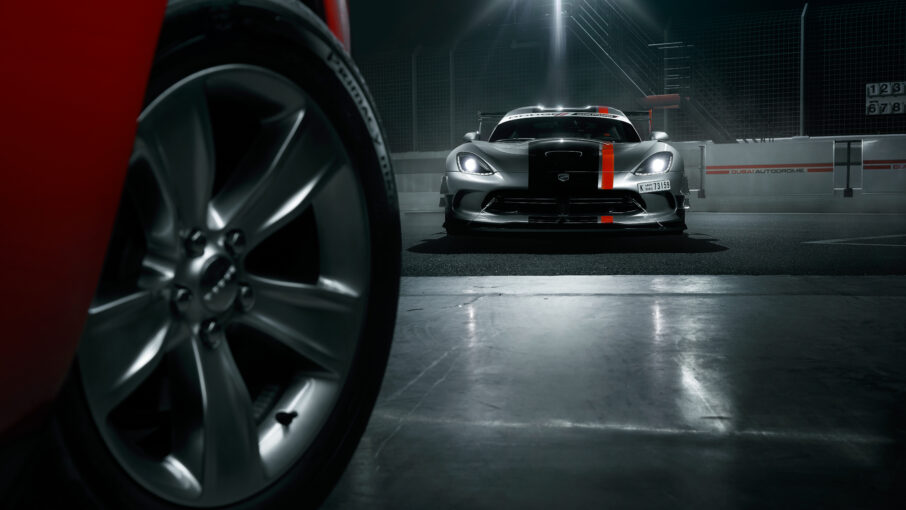

DRIVEN. SRT Viper ACR (2016)
Features | EVO Middle East | crankandpiston
This is the most mental version yet of SRT’s Viper. So, how will fare it during hot laps of the Dubai Autodrome?
Originally posted – 20 July, 2015




crankandpiston.com / EVO Middle East magazine (PDF)
You join me on the main straight of the Dubai Autodrome, sitting bolt upright in a carbon fibre-backed bucket seat barrelling into the first corner at well over 200 kph. The bass fury of a roaring V10 is making it nearly impossible to hear my instructor. The orange cone that marks my braking point whizzes past my field of vision and I stand on the middle pedal. The mere act of doing so, thanks to the massive Carbon Ceramic brakes at my disposal, knocks the air from my lungs.
Down a couple of gears and I’m pointing the nose at the apex before winding the power back on. And there’s no movement. None whatsoever. The front end is pinned to its line and the rear end obediently follows suit. The only subtle shift of momentum is my helmet as it makes a bid for freedom against the driver’s side window.
It boggles my mind that, not only has my neck survived this assault, but that the weapon I’m throwing at the track is 100 per cent road legal.
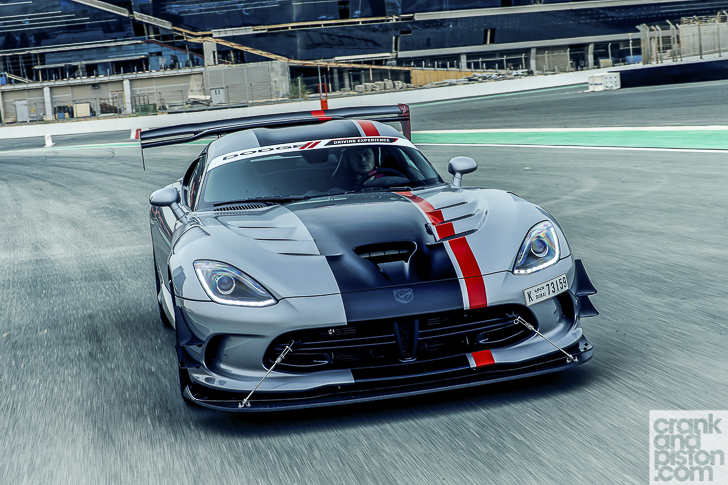
Rewind the clock two hours. I’m in a less than bolt-upright position being given the ins and outs of the new SRT Viper ACR. It’s the latest in a reasonably long line of American Club Racer machines that first appeared in 1999 as a performance-focused second-generation Viper. While its debut last year was overshadowed by two 707 bhp Dodge Hellcats, it wasn’t long before the ACR was making headlines: in the space of just a few months, the ACR broke 13 production lap records across North America, including at Laguna Seca and Road America. This not only set the Viper ACR up for a stab at the Nürburgring’s production car record (an accolade its predecessors held in both 2008 and 2011), but it also gave the ACR more lap records than any other production sports car on sale today. All the more impressive considering that – just to remind you – this demon is 100 per cent road legal.
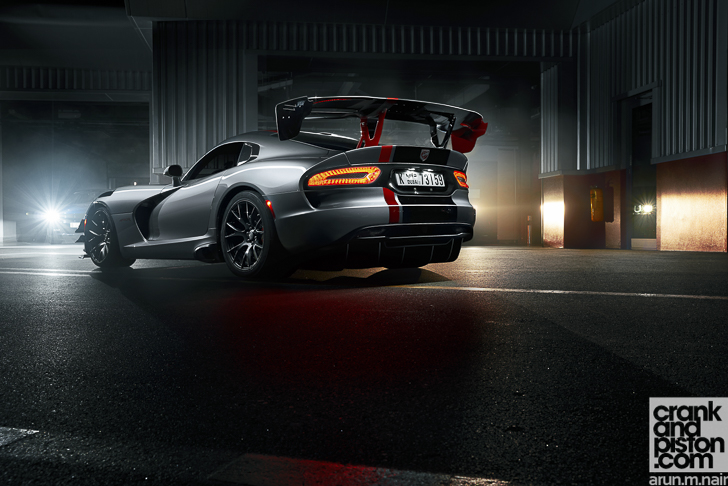
It’s these accolades that are causing my mind to wander during a slightly-too-patronizing driver’s briefing. Though our genial hosts are keen to make sure we know the correct lines and the optimum seating position – understandable when dealing with a $122,500 supercar – I can’t help but stare at the star of today’s show itself, stage left. On top of the Viper’s already threatening physique lies the Extreme Aero Package, SRT’s most performance-focused setup. The enormous rear spoiler, an extended front splitter and carbon fibre rear diffuser makes the overall look even more badass, as well as providing nearly one ton of peak downforce at 285 kph. Sneeze under those conditions, and you’ll probably lose an eye.
Clearly my muted musings have attracted the attention of Michael Mintgen, head honcho of the three-man engineering outfit sent from Germany specifically to maintain the Viper for today’s track test. The team was also on-hand during the 2011 Nordschleife lap record attempt, done, thanks to the sudden onslaught of rain, in just two laps and with only 30 minutes to work with. Good God, what kind of machine is this?




“This is the most extreme package you can buy at the moment,” Michael mentions, offering a mighty handshake as he sits down beside me. “The brakes are huge – 390mm on the front, 360mm at the rear – with big calipers. We’ve also adjusted the dampers and springs to lower the car for more downforce. That took a while to get right, because, if you go too low, the car bottoms out and you lose the balance. Those dive planes can only do so much. And those tyres” – pointing – “are specially developed by Kumho Ecsta for this car. At the back, we’re running 355/30m, which are the biggest you can get.”
So, how much running has the car done since it arrived?
“A lot! I’ll have to check to see how many laps we’ve done” – turns out it’s close to 100 – “but the car arrived with 10km on the clock, and this morning it creeped over 850km. Y’know what’s even more impressive? We haven’t had a single mechanical issue with the car. We haven’t even changed the brakes.”
A customs issue means replacement Kumhos shipped from the US are still trapped in Abu Dhabi, and though there should (just) be enough rubber left to complete my run, the prospect of a mechanical failure arriving at the 11th hour and bringing my drive to a close is more than I can bear.
Still, chin up. Quite literally in fact as I’m shuffled away from the Viper to grab a helmet before being introduced to ADAC GT Masters and VLN regular Heiko Hammel, my instructor for the day. Cue another firm handshake. Must be something they put in the water.
“First thing you must remember is that you can’t drive this like a Porsche or Audi R8,” Heiko explains. “It’s completely different. It’s a Viper, and it’s baaad! So you have to drive aggressively to drive fast, because the rear wing and the diffuser give you so much traction. When you’re really on the limit you must work with the car, because otherwise it will show you no mercy.”
No mercy. From a $112,000 supercar boasting a 645 bhp 8.4-litre V10. Gulp…
Before walking me through what to turn where, and when to scream, Heiko makes sure I’m comfortable in the bucket seat before arming the bomb. And I’m in for a bit of a shock. Whilst the outside fits SRT’s line that the Viper is “more of a street-legal race car than a track capable street car,” the inside is anything but, save perhaps the aftermarket data recorder mounted on the windscreen. There’s no roll cage, for instance. No fire extinguisher. And, aside from some aluminium door sills – which I’m encouraged not to touch as they’re obscenely hot after a few testing laps – getting in and out is easy.
There’s plenty of legroom, and just enough headroom even with my helmet on, thanks to the double bubble roof. The Viper’s Alcantara and mixed leather upholstery remains, as does a three-speaker audio system. There’s even a couple of cupholders just behind my right elbow.
Where perhaps the insanity of the exterior can be felt in the cabin is with the pedals, which are slightly off-centre. It doesn’t feel like I’m sitting sideways, but it does take a little getting used to. Not just because the slimmed down dead pedal had been mounted higher up on the bulkhead. My bemusement has clearly amused Heiko, who then draws my attention to the short shift manual gearbox.
“Down the main straight, when you arrive at 240 kph and shift hard down into third, you need to play with the throttle. When you brake hard, the big V10 nods, and the rear gets very light and lifts up. If you don’t play with the throttle, you’ll have too much negative torque.”
He’s also quick to point out the switch key plugged into the ECU where normally you would find the bonnet release (which, in a neat touch, is mounted inside the air intake behind the driver’s side wheel). Said key records yet more data from my run, and Heiko suggests that I “not kick it out” for fear of destroying four days of work before pressing the understated Stop/Start button and firing the V10 into life. On the information screen in front of me, a sneering Viper rolls over red. Here we go.

I had thought, much as you may have done, that my first impressions would be on the V10. Those will come later though, as it’s the length of the clutch pedal that immediately grabs me. The biting point is almost absurdly high, and, when found, snatches quickly, the Viper semi-bunny-hopping in tandem and the revs dropping dramatically from their 3-4,000 rpm idle.
Fortunately, something other than the Arabian sunlight is shining down on me, and I manage to avoid stalling as the front tyres start to creep. There are a few moments before I hit the end of the pitlane and can start to build up the power. In front of me, the speedometer goes up to a dizzying 340 kph as the V10 begins emitting low, devious rumble.
On my first lap, and heeding Heiko’s advice for self-preservation, the first corners are taken gently. 645bhp is sent leisurely to the rear wheels as I massage the right pedal rather than assault it. Not something the V10 was expecting after several days of punishment as the bark from the exhaust reminds me. Already though, the sensation of grip is enormous. In fact, Michael and his team have already registered a colossal 1.4g on the Autodrome’s Club Circuit earlier this morning. On used tyres. With full tanks. On vapours, and with fresh rubber, Heiko is confident the ACR could go three seconds quicker. Impressive stuff, given that a Porsche 911 GT3 RS would be only two-three seconds in front.
Clearly, the Viper can handle the abuse – 13 lap records confirm that – and as I cruise round the final long corner on my out lap, knowing I have only limited time with the ACR, I think, “to hell with it,” and nail it down the straight.
The pick-up is astonishing. The enormous torque and power is delivered violently as the revs rocket up. So much so that I fluff my first manual gear change at pace, and can manage ‘only’ 220 kph before reaching the braking point and slamming the carbon ceramic discs on.

The deceleration is like hitting a tree. Heiko’s warning springs to mind too, as the shift in weight over that already heavy V10 means the rear end lightens up dramatically. The front wheels stay rooted, but I can feel the back end squirrelling as the tyres desperately try to regain composure. Distracted by the sensation, and having braked earlier than I ideally should have done (again, self-preservation), I’ve scrubbed off more speed than expected, and have to wait a beat before turning into the first high-speed corner.
The data recorder has been switched off for my run – whether to save the battery or my dignity, I’m not entirely sure – but already the traction at my disposal is immense. The front end sticks unconditionally to the line with no trace of understeer at all. Having regained their composure, the rear wheels, by now, have also fallen into line, and there’s no movement at all as I start feeding the power back in towards the upcoming left-right hander.
Back on the brakes, and turning the nose in again, the sensation through the wheel is breathtaking. Perfect 50:50 weight distribution means there’s a beautifully neutral poise to the Viper as it switches quickly and cleanly from left to right. Heiko mentions over the V10 explosion that, through here, 110 kph “should be easy.” But an unexpected issue, and slightly less talent, means I’m unlikely to match this. In my haste to get out on-track, I’ve also, rather embarrassingly, moved the seat too far forward on the runners. As I lift my foot from the lengthy clutch pedal, my knee ends up exactly where my left hand needs to go. I’m effectively driving the left-hand corners one handed. Fortunately there are only three of them.
There’s another burst of volcanic acceleration as I ‘ker-chuck’ another short-shift gear-change – I’m getting the hang of it now – and start winding the power back in onto the next straight.
Side-mounted exhausts mean that the V10 soundtrack is deep and unapologetically booming, designed only to rattle the lungs and any other internal organs of the driver. Indeed, were it not for the view I have over my shoulder and through the menacingly short windscreen, I’ve no doubt the ferocity of both the V10’s guts and lungs would, mostly, be all I can talk about on the straights. As the balance alone has emphasised though, things are not quite that simple. The even larger rear spoiler makes visibility ‘ambitious’ at best, and the sheer length of that undulating bonnet stretching way out in front of me – and shaking violently – is almost haunting. Alongside the landscape flying in a blur past the driver’s window, it’s a stunningly if slightly ominous sensation of speed.


I still have a few laps to go before time is called on my experience, but, quite honestly, my mind is made up after two corners. As a road-going supercar, I’ve no doubt the ACR would be civil enough on the inside, if perhaps a logistical nightmare on the outside (I can’t imagine that extended front splitter would survive too many road humps). But as a track weapon, the Viper is an utter beast.
The ferocity of that V10 and the resultant, booming soundtrack might have your first impressions convinced the ACR is a barely controlled lunatic through the corners, akin to its Hellcat step-siblings. And yet, despite its menacing presence, the ACR is astonishingly well-balanced. Almost dignified through the corners. Direction changes, despite the weight over the front axle, is done with millimetric precision thanks to un-exhaustive grip and a superbly engineered chassis. It perhaps lacks the cabin civility one might hope of a supercar (certainly not through lack of trying), and questionable visibility both front and back might make you think twice about your track weapon of choice should $122,500 be burning a hole in your pocket. But make no mistake. The SRT Viper ACR is utterly superb.
Also, it’s 100 per cent road legal. Did I mention that?
Images | Awesome Group, Arun M Nair, Harisanker S and Nick England
Features | EVO Middle East | crankandpiston | James Gent